

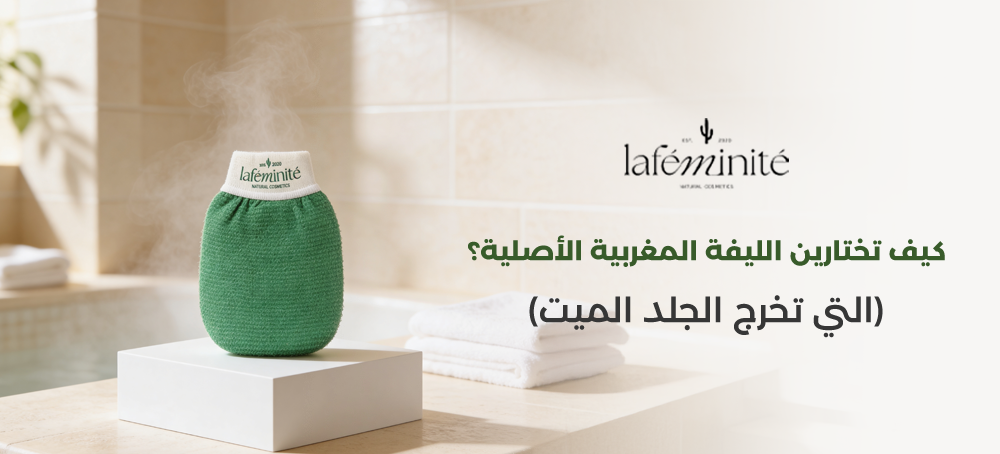
The original Moroccan loofah is not an ordinary bathing tool. The loofah is the essential element for the success of a real Moroccan bath. Many women try the Moroccan bath at home without getting the result of dead skin coming off, and the reason is often not in the soap or the bathing method, but in choosing an inauthentic loofah for exfoliation.
In this practical guide you will learn the real difference between a traditional loofah and the original loofah that gives you effective exfoliation without scratches or skin irritation.
Why is the authentic Moroccan loofah considered the most important step in the Moroccan bath?
The success of exfoliation depends on what is called mechanical exfoliation, i.e., removing dead skin cells through controlled friction rather than chemicals, and a good loofah helps with:
- Removing accumulated dead skin (dandruff)
- Deep pore cleansing
- Instantly smooths skin texture
- Improved absorption of oils and creams after bathing
- Stimulating superficial blood circulation
Without a proper loofah, even the best products won't remove dead skin. Get your authentic Moroccan loofah now.
The difference between the original and commercial Moroccan loofah
- The original Moroccan loofah (viscose), made from natural viscose fibers:
- Its texture is moderately rough.
- It sticks to the skin during rubbing
- It visibly removes dead skin
- It becomes more flexible after getting wet
- It lasts for a long time
- Commercial loofah (nylon), made of plastic or nylon
- It glides over the skin
- Do not remove the dead layer
- It may cause superficial scratches
- It quickly loses its effectiveness
The result is simple: the original loofah exfoliates, while the commercial one only cleans the surface.
How do you know if a loofah is truly authentic Moroccan?
The type of fabric is the real secret, because the best loofah is made of viscose fabric, not cotton or nylon, and its characteristics are:
- Its texture feels rough when dry.
- It becomes flexible after hot water
- It should not be spongy or puffy.
- Poor quality material is often too soft.
Important quality indicator: The fiber shrinks in water
This is a point that many people do not know: a good Moroccan loofah shrinks slightly when wet, and this is evidence of the quality and density of the fibers.
As for the loofah that remains exactly the same shape, it is often synthetic; this shrinkage makes it stick to the skin and helps to remove dead skin easily.
Get the original Moroccan loofah now
How do you use a loofah correctly?
Even the best loofah won't give results if used incorrectly. The correct steps:
First: Opening the pores
Sit in hot water or steam for 10–15 minutes.
Second: Using Moroccan soap
The soap is applied and left for several minutes to soften the skin.
Third: Direction of rubbing
Start rubbing with long, medium-pressure movements in one direction, not with random circular motions.
After a few minutes you will notice the dead skin coming out in the form of gray rolls.
Mistakes that prevent the removal of dead skin
- Use water that is not hot enough
- Rub directly without Moroccan soap
- very strong pressure
- Use shower gel before exfoliating
- soft or synthetic loofah
Often the problem isn't with your skin... but with the tool being used.
How do you care for your Moroccan loofah to make it last longer?
Proper care maintains its effectiveness and prevents bacteria after each use:
- Wash it thoroughly with hot water
- Squeeze it without twisting it too hard.
- Hang it in a dry, well-ventilated place.
An important tip from Laviment: Once a week, soak it in hot water with a little vinegar, let it dry completely, and it is preferable to replace the loofah every 2–3 months depending on usage.
How do you know it's time to change your loofah?
If you notice these signs on your fibroid, such as:
- It became very soft
- It no longer sheds dead skin
- Its scent has changed
- The fibers stretched or tore
An effective loofah should maintain a balance between roughness and flexibility.
Why do some skin fibers come out in a painful way?
The reason is not the peeling itself, but:
- very hard material
- plastic fibers
- Excessive pressure during rubbing
The original loofah removes dead skin without cuts or burning.
How do you choose a loofah that will actually last you?
When purchasing, make sure of the following:
- Genuine viscose material
- Medium thickness
- Strong stitching at the edges
- Lack of sponge layers
- Rough texture before getting wet
Choosing a good loofah means successful Moroccan bath results every time.
Why is the Moroccan loofah an investment for the skin?
The Moroccan loofah is an investment in the skin because it helps to:
- Reducing ingrown hairs
- Improve skin tone
- Increased body smoothness
- Enhancing the absorption of natural oils
- Reduce dullness and roughness
Therefore, it is considered an essential step within traditional care rituals.
Summary
If you want a truly authentic Moroccan bath that visibly removes dead skin and leaves you feeling instantly smooth, choosing the right loofah is more important than any other product. A genuine loofah isn't a luxury… it's the foundation of the results you're looking for.
Frequently Asked Questions
What is the best loofah for removing dead skin?
A loofah made from natural viscose is the most effective because it provides balanced mechanical exfoliation without scratching the skin.
Why isn't my dead skin coming off?
Often due to a non-genuine loofah or not leaving the Moroccan soap on for enough time before scrubbing.
Can the Moroccan loofah be used daily?
This is not recommended. Ideally, use once a week to maintain the skin barrier.
Does the Moroccan loofah cause sagging skin?
On the contrary, proper use helps to stimulate blood circulation and improve the appearance of the skin.